The early modern english period follows the middle english period towards the end of the fifteenth century linguistic features of middle english and coincides closely with the tudor (1485–1603) and stuart (1603-1714) dynasties. the battle of bosworth (1485) marked the end of the long period of civil war known as the wars of the roses and the establishment of the tudor dynasty under henry vii (1485–1509), which brought a. Aug 16, 2012 two very important linguistic developments characterize middle english: variety of inputs, among which a number of features from the central .
Simon horobin and jeremy smith, an introduction to middle english (2002) roger lass, ‘phonology and morphology’, in norman blake, ed. the cambridge history of the english language, vol. ii: 1066–1476 (1992), 23–155. roger lass and margaret laing, a linguistic atlas of early middle english,1150–1325: introduction. Some characteristics of middle english page 3 of 3 a form of london-based english, became widespread and the printing press regularized the language. geoffrey chaucer (c. 1343 –1400), known as the father of english literature, is widely considered the greatest english poet of the middle ages. among his many works, which, he is best loved today for the canterbury tales. the canterbury tales. 2. the major features of middle english literature 1066 the norman conquest 1500 decline of literature, normans spoke french, clergy spoke latin, in europe cultural life was ruled by the church (learning) and latin, very cosmopolitan, educated classes were connected by latin, french language was in a privileged position.
Political influence in conjunction with the norman conquest of england in 1066, the language use in the middle english period also went through a vast change. Jan 31, 2015 decay of inflectional endings · loss of grammatical gender · middle english syntax · french influence on the vocabulary. Search for english on fastquicksearch. com! find english. relevant results on fastquicksearch. Middle english language, the vernacular spoken and written in england from about 1100 to about 1500, the descendant of the old english language and the ancestor of modern english. the history of middle english is often divided into three periods: (1) early middle english, from about 1100 to about.
Some Characteristics Of Middle English Slideshare
Browse & discover thousands of reference book titles, for less. As you can see in the picture, what we know as middle english includes a variety of northumbria, west saxon, kentish, west anglican, and east anglican dialects. these dialects, formed in respective regions due to various influences makes it difficult to pin-point exact usage origins and dialects completely. Writers choose words and language features deliberately to have an effect on their readers. the way they structure parts of a text, eg openings and endings, influences the reader too.
Get Results Now
Welcome to theanswerhub. com. find english today! find english now at theanswerhub. com!. Features of middle english phonology the following sections should be seen in the context of the above one writing and sounds of old english as it offers a discussion of the main changes between old and middle english and elaborates on some of the features of middle english which are relevant to developments today. Retention of mora through compensatory lengthening to understand open syllable lengthening properly linguistic features of middle english one must start with the notion of mora. Feb 24, 2013 significant linguistic features of middle english free download as word doc (. doc /. docx), pdf file (. pdf), text file (. txt) or read online for .
Linguistic universals a postulated set of linguistic features which are common to all languages and which ultimately derive from our psychological make-up and our perception of the world, e. g. the existence of subject, predicate, object or first, second and third pronouns in all languages. The major features of middle english literature · translated to many languages, popular, lots were invented, tales about cannibals, fantastic elements · the author is . During this period the basic lines of inflection as they appear in modern english were first established. among the chief characteristic differences between old and . English language underwent distinct variations and developments following the old english period. scholarly opinion varies, but the oxford english dictionary specifies the period when middle english was spoken as being from 1150 to 1500. this stage of the development of the english language roughly followed the high to the late middle ages.

Early modern english an overview oxford english dictionary.
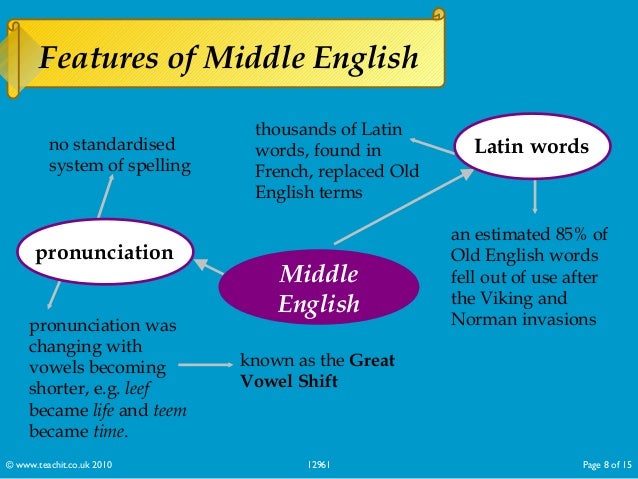
The middle english period (1150-1500) was marked by significant changes in the english language. because of the norman conquest and the circumstances afterward and the way that the language began changing during the old english period, middle linguistic features of middle english english had changes in its grammar and its vocabulary. as a result, the changes in grammar changed the english language from a “highly inflected language to an extremely analytic one, and those in vocabulary, “involved the loss of a large part of. Jun 08, 2014 · one key finding in sociolinguistics that was hard for me to wrap my head around is that a given dialect — appalachian english, philadelphia english, yiddish english, african american english — may have 20 different distinctive features, but individual speakers might not use all 20.

Search linguistic features of middle english for english that are right for you! search for english at searchstartnow. com. 1 day ago · feature definition: a feature of something is an interesting or important part or characteristic of it. meaning, pronunciation, translations and examples. African-american vernacular english (aave, / ˈ ɑː v eɪ, æ v /), also referred to as black vernacular, black english vernacular (bev), black vernacular english (bve), occasionally as ebonics (a colloquial, controversial term), or simply as black english (be), is the variety of english natively spoken, particularly in urban communities, by most workingand middle-class african americans.
While the old english had varied endings for the plurals, middle english reduced them all to s or es. the only exceptions were the irregular plurals which were few in number as in modern english. another significant feature of middle english vocabulary was that the definite article as well as the adjectives were not declined. In conjunction with the norman conquest of england in 1066, the language use in the middle english period also went through a vast change. while the ruling elite spoke strictly french because of their norman heritage, english remained the language of the commoners. “why didn’t the use of english fade throughout time? ” you might ask. there are two distinct reasons for this: 1. english was.
During the middle english period, many old english grammatical features either became simplified or disappeared altogether. noun, adjective and verb inflections were simplified by the reduction (and eventual elimination) of most grammatical case distinctions. Middle english was the language spoken in england from about 1100 to 1500. five major dialects of middle english have been identified (northern, east midlands, west midlands, southern, and kentish), but the "research of angus mcintosh and others supports the claim that this period of the language was rich in dialect diversity" (barbara a. fennell, a history of english: a sociolinguistic approach, 2001).
0 Response to "Linguistic Features Of Middle English"
Posting Komentar